


80
/ 100
SEO score
The Scrum methodology is a process in which a set of good practices are applied regularly to work collaboratively, as a team, and get the best possible result from a project. These practices support each other, and their selection comes from a study of the way highly productive teams work.
In the Scrum methodology, partial and regular deliveries of the final product are made, prioritized by the benefit they bring to the recipient of the project. That is why the Scrum methodology is especially suited to projects in complex environments, where you need to get results early, where the requirements are changing or poorly defined, where innovation, competitiveness, flexibility and productivity are fundamental.
The Scrum methodology is also used to solve situations in which what the customer needs is not being delivered, when deliveries take too long, costs skyrocket or quality is not acceptable, when you need the ability to react to the competition, when team morale is low and turnover is high, when it is necessary to identify and fix inefficiencies systematically or when you want to work using a process specialized in product development.
See in detail what the benefits of the Scrum methodology are, its foundations and its requirements. In the Scrum process a project is run in short, fixed-length time cycles (iterations, which are normally 2 weeks, although some teams use 3 and even 4 weeks, the maximum limit for real product feedback and reflection). Each iteration has to deliver a complete result, an increment of the final product that can be delivered to the customer with minimum effort when they ask for it.
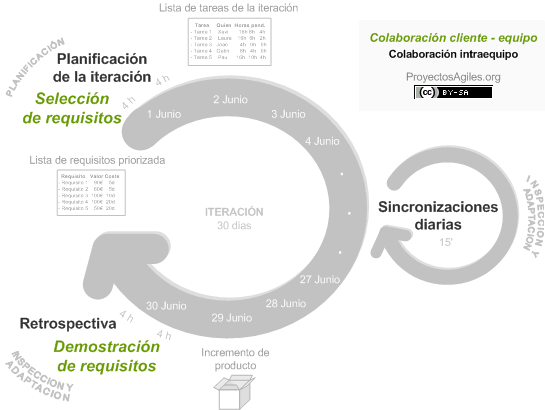
The process starts from the product’s prioritized list of goals/requirements, which acts as the project plan. In this list the customer (Product Owner) prioritizes the goals by balancing the value they bring against their cost (which the team estimates considering the Definition of Done) and they are distributed across iterations and deliveries. The activities carried out in the Scrum methodology are the following (the times shown are for 2-week iterations): Iteration planning.
On the first day of the iteration the iteration planning meeting is held. It has two parts:
- Requirement selection (2 hours). The customer presents the team with the prioritized list of requirements of the product or project. The team asks the customer any questions that arise and selects the highest-priority requirements it expects to complete in the iteration, so they can be delivered if the customer asks for them.
- Iteration planning (2 hours). The team builds the iteration task list needed to develop the selected requirements. Effort estimation is done jointly and team members self-assign the tasks. They self-organize to work even in pairs (or larger groups) in order to share knowledge (creating a more resilient team) or to solve especially complex goals together.
Iteration execution. Every day the team holds a synchronization meeting (15 minutes), usually in front of a physical board or whiteboard (Scrum Taskboard). The team inspects the work the others are doing (dependencies between tasks, progress toward the iteration goal, obstacles that may prevent this goal) so it can make the adaptations needed to meet the forecast of goals to show at the end of the iteration. In the meeting, each team member answers three questions:
- What have I done since the last synchronization meeting to help the team meet its goal?
- What am I going to do from now on to help the team meet its goal?
- What impediments do I have or will I have that prevent us from reaching our goal?
During the iteration the Facilitator (Scrum Master) makes sure the team can keep its focus to meet its goals.
- Removes the obstacles the team cannot solve by itself.
- Protects the team from external interruptions that may affect the iteration goal or its productivity.
During the iteration, the customer together with the team refine the requirements list (to prepare them for the next iterations) and, if necessary, change or replan the project goals (10%-15% of the iteration time) in order to maximize the usefulness of what is developed and the return on investment.
Inspection and adaptation.
On the last day of the iteration the iteration review meeting is held. It has two parts:
- Review (demo) (1.5 hours). The team presents to the customer the requirements completed in the iteration, in the form of a product increment ready to be delivered with minimum effort. Based on the results shown and the changes in the project context, the customer makes the necessary adaptations objectively, from the very first iteration, replanning the project.
- Retrospective (1.5 hours). The team analyzes how it has worked and which problems could prevent it from progressing properly, continuously improving its productivity. The Facilitator is in charge of removing or escalating the identified obstacles that are beyond the team’s scope of action.
You may also be interested in: Business Model: what is it and how to create your Canvas model?
How the Scrum methodology provides these benefits
Below we detail how the Scrum methodology makes it possible to achieve each of the benefits above:
| Benefits of the Scrum methodology | How they are achieved |
| Regular management of customer expectations. The customer sets their expectations by indicating the value each project requirement brings and when they expect it to be completed. | Prioritized requirements list. The customer creates and manages the list of requirements of the product or project, which reflects their expectations in terms of requirements, value, cost and deliveries. |
| The customer regularly checks whether their expectations are being met, gives feedback, can make informed decisions from objective results from the very start of the project, and steers these project results, iteration by iteration, toward their goal. Effort and time are saved by avoiding assumptions. | Demonstration of project results in each iteration. At the end of each iteration the team shows the customer the requirements it has managed to complete. After inspecting the real result of the project up to that moment, and considering the effort it took, the customer requests the changes needed and replans the project. |
| Early results (“time to market”). The customer can start using the most important results of the project before it is completely finished. Following the Pareto law (20% of the effort provides 80% of the value), the customer can start recovering their investment (and/or self-funding) earlier by starting to use a product that only lacks minor features, can bring a product to market before their competitor, can handle urgent matters or new customer requests, etc. | Prioritization of requirements by value and cost. At the start of each iteration the customer prioritizes the list of requirements of the product or project based on the value they bring, their development cost and the project risks, changing the planned requirements to react to context changes in the project. Project progress is measured by the requirements the team completes in each iteration. |
| Flexibility and adaptation. Regularly the customer redirects the project according to their new priorities, changes in the market, completed requirements that let them understand the product better, the real development speed, etc. At the end of each iteration the customer can use the part of the product completed up to that moment to run proofs of concept with users or consumers and make decisions based on the result. | Replanning at the start of each iteration. Changes are assumed to be a natural part of the project. Every iteration starts with a replanning of the project. This replanning is not traumatic, since the Scrum methodology minimizes the number of goals/requirements the team works on (WIP, Work In Progress) to those that fit in an iteration. No effort has yet been made to develop the requirements of the following iterations. The fact that requirements are completed according to the value they bring to the customer minimizes the probability of big changes during the course of the project. |
| Return on investment (ROI). Regularly the customer maximizes the ROI of the project. When the benefit still to be obtained is lower than the development cost, the customer can end the project. | Prioritization of requirements by value. In each iteration the customer has some completed requirements and replans the project based on the value the pending requirements bring compared with their development cost. |
| Risk mitigation. From the first iteration the team has to manage the problems that may appear in a project delivery. By making these risks visible, it is possible to start mitigating them early. “If you have to make a mistake or fail, better to do it as soon as possible.” Early feedback saves effort and time on technical errors. The amount of risk the team faces is limited to the requirements it can develop in one iteration. The complexity and risks of the project are naturally split into iterations. | Iterative and incremental development. A requirement must be completed in one iteration. The team must carry out all the tasks needed to complete it and have it ready to be delivered to the customer with the minimum effort needed. This way, no risky activity related to the delivery of requirements is left for the end of the project. |
| Productivity and quality. Regularly the team improves and simplifies the way it works. | Continuous improvement. In each iteration the team holds a retrospective to analyze the way it works and identify the obstacles that prevent it from moving at the best possible pace. |
| Team members synchronize their work daily and help each other solve the problems that may prevent reaching the iteration goal. Communication and adaptation to the different needs among team members are at their maximum (adjusted iteration by iteration), so unnecessary tasks are not carried out and inefficiencies are avoided. | Daily team communication. Every team member knows how the work of the other members affects their own and what the needs of the others are. |
| People work more focused and more efficiently when there is a short-term deadline to deliver a result they have committed to. Awareness of this time limit favors prioritizing tasks and forces decision-making. Iterations (Sprints) are regular and one month long to make systematic synchronization with other teams, with the rest of the company and with the customer easier. | TimeBoxing. Each activity in the Scrum methodology always has the same duration (1 month, 4 hours, etc.), so people learn what they can achieve in this time, how to organize themselves, prioritize tasks and make decisions. |
| The team minimizes its dependence on outside people in order to move forward (depending on the availability of others can stop tasks). | Multidisciplinary team. The team is made up of all the people with the specialties needed to carry out the project. |
| Effort estimation and task optimization to complete a requirement are better when done by the people who will develop the requirement, given their different specializations, experiences and points of view. Also, with short iterations the accuracy of estimates increases. | Joint effort estimation. At the start of the iteration, team members jointly estimate the effort needed to complete the requirements and their tasks. |
| People work more efficiently and with more quality when they themselves have committed to deliver a result at a given time and decide how to do it, not when they have been assigned a task and told the time needed to do it. | Team commitment. At the start of each iteration the team selects the requirements it commits to complete and deliver at the end of the iteration (responsibility). The team organizes itself (authority), identifying the necessary tasks and their effort, with each member self-assigning the tasks they commit to carry out. |
| The team avoids walking for a long time down the wrong path that would force it to make a big effort to reach the expected goal. Product quality is ensured systematically and objectively, in terms of customer satisfaction, requirements ready to be used and internal product quality. | Demonstration of ready-to-use results and sustained speed. On one hand, at the end of each iteration the team shows the customer the requirements it has managed to complete, so they are fully operational. On the other hand, to have a sustained development speed, the team needs to develop each product increment without having to revisit poorly solved aspects from earlier iterations. |
| Alignment between customer and team. The results and efforts of the project are measured in terms of goals and requirements delivered to the business. All project participants know the goal to achieve. The product is enriched with everyone’s contributions. | Customer and team working “as a team”. In each iteration the team and the customer work together on creating the project requirements (in the estimation of the prioritized list of project requirements), on detailing them (in the iteration planning meeting) and on analyzing the result obtained (in the demonstration of completed requirements). |
| Motivated team. People are more motivated when they can use their creativity to solve problems and when they can decide how to organize their work. | Self-managed team. The team is the one that commits to completing certain requirements in an iteration and the one that best knows how to develop them. That is why the team self-organizes and plans how it will work in the iteration. |
| People feel more satisfied when they can show the achievements they make. | Demonstration. In each iteration the team shows the customer the results it achieves. It does not spend months working without being able to show its work. |