


Since the so-called “Digital Omnibus” on AI was approved, it is often said that Europe has postponed the AI Act. I understand why it is told that way, but it is only half true. And the half that has not been postponed is exactly the one that affects any team using AI tools in their daily work, like mine. A warning: I am not a lawyer and this is not legal advice.
In short: The AI Act has not been postponed in full. The prohibited practices and AI literacy remain in force, the transparency rules of Article 50 apply from 2 August 2026, and only high-risk systems have been postponed (to December 2027 and August 2028).
AI Act postponement: the dates in a table
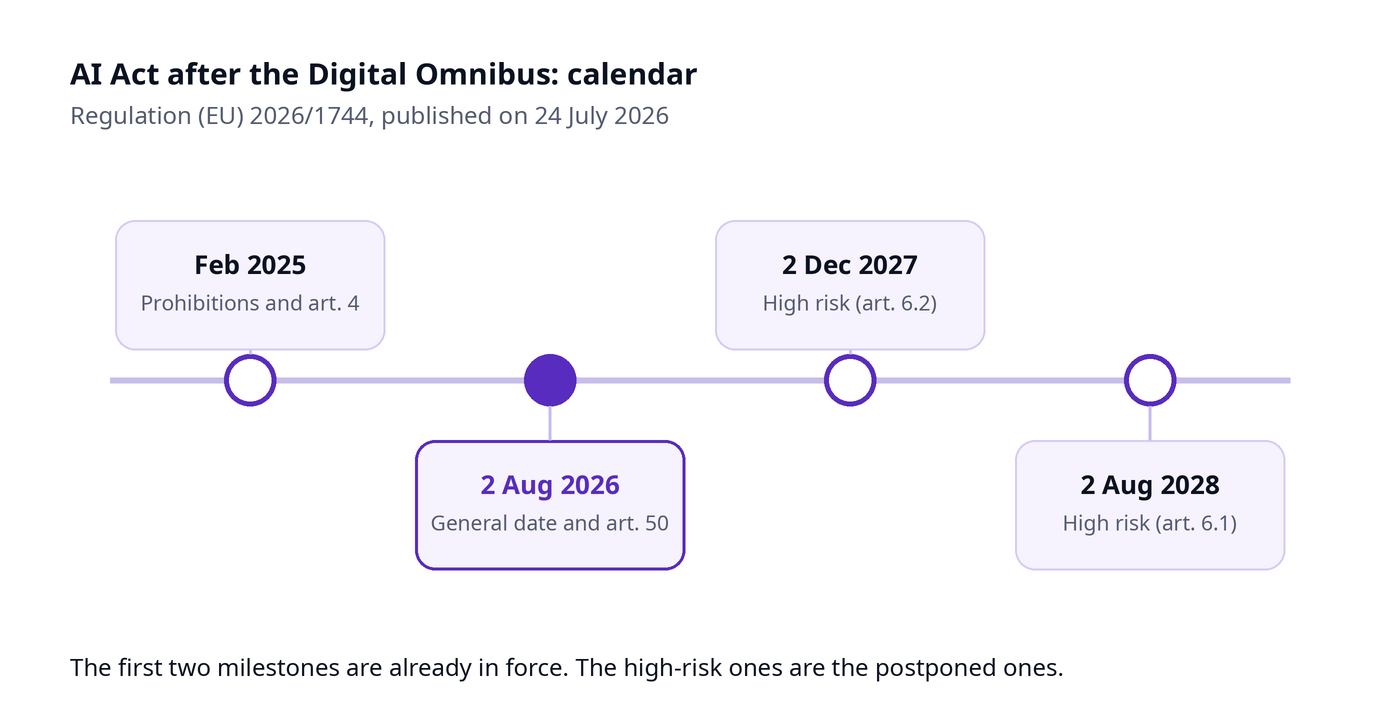
We are talking about Regulation (EU) 2026/1744, the Digital Omnibus on AI, published in the Official Journal of the EU on 24 July 2026.
| What | When |
|---|---|
| Prohibited practices and Article 4 (AI literacy) | Still apply, since February 2025 |
| General date of application of the regulation | 2 August 2026 |
| Transparency, Article 50 | From 2 August 2026 (four-month transition for generative AI providers already on the market before that date) |
| High risk, Article 6.2 | Postponed to 2 December 2027 |
| High risk, Article 6.1 | Postponed to 2 August 2028 |
What moves in the AI Act mostly affects those who develop or deploy high-risk systems. What stays in place affects almost everyone who uses AI.
Article 4 of the AI Act also changes. Before, it required ensuring a sufficient level of AI literacy. Now it asks to take measures to support the development of that literacy among staff and those who use the systems on the company’s behalf, according to their context, without guaranteeing a specific level for each person. The tone changes. The obligation does not disappear.
Three typical situations
These are not anecdotes of mine, they are common scenarios in any team that uses AI, and each one asks for something different.
One person tries a tool and everyone else copies it
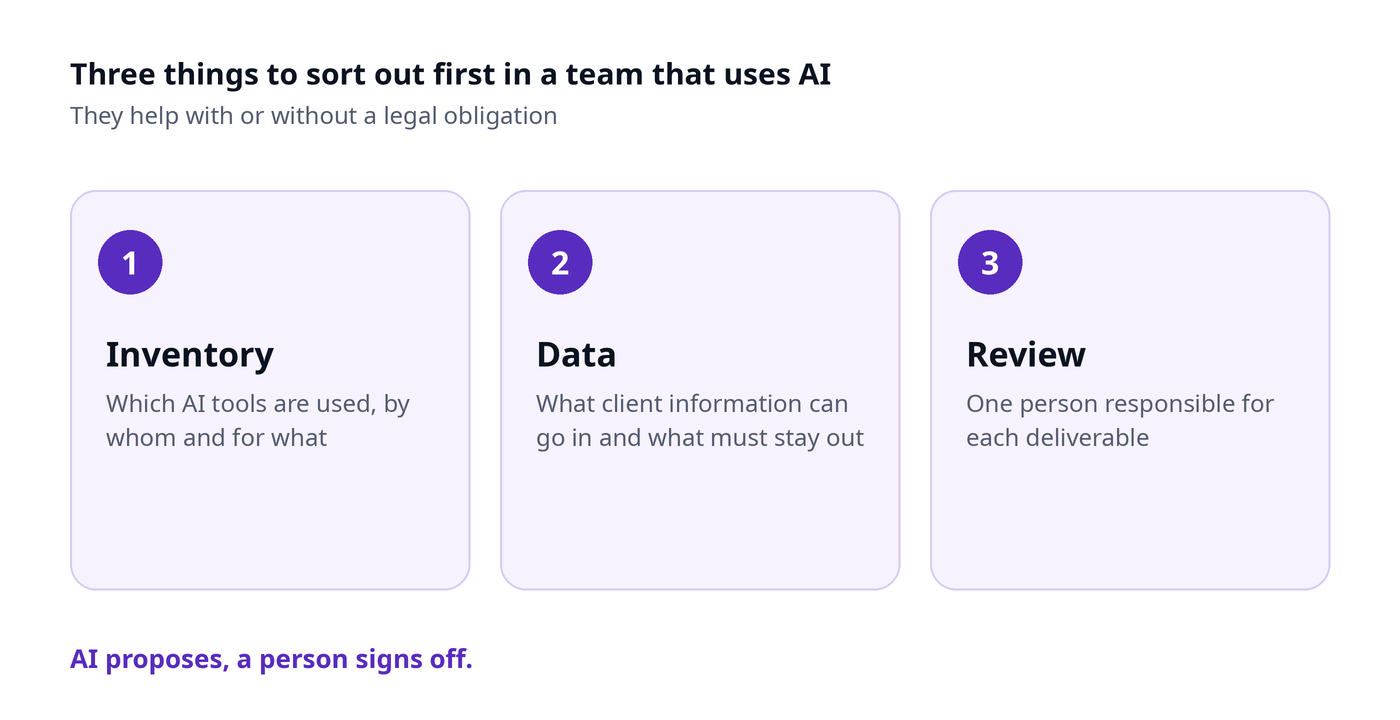
It starts with someone who saves time summarizing meetings. Some time later half the team is using it, each with their own account and their own data. Nobody did anything wrong, but nobody decided anything. The first step is a simple inventory: which tools, who uses them and for what. A shared table is enough.
A deliverable comes out well written and nobody knows who reviewed it
AI proposes well-written texts that look true. That is the risk: that what is well written gets confused with what is verified. What helps here is a simple rule: each delivery has a person responsible for the content, whether it was written with AI or without it. AI proposes, a person signs. And if something has been generated with AI and is delivered as if it hadn’t, there is a trust problem before a legal one, so it is worth deciding with the client when to say so.
Several suppliers in the same team
This is where it is hardest to keep a common criterion. Each supplier brings its own tools and internal rules, and the project lead is the one who sees them all together. What helps is putting a few common minimum rules in the collaboration agreement: which client data never leaves approved environments, how to flag when AI is used in a deliverable and who answers for the review. It doesn’t have to be long. It has to be signed.
My starting point
I write as someone who coordinates a large team, with several suppliers, and who uses AI daily: assistants like Copilot and ChatGPT, tools like Cursor and agents for project control. What worries me is not the fine. It is something more everyday: that each person uses the tool they like, with the data they like, without anyone having talked about it. That is not an AI problem. It is a management problem, the same one that already existed with personal spreadsheets holding client data that nobody else knew about.
Where I would start, in four weeks
A modest plan, for a team that has nothing written down. In the first week, make the tool inventory, asking without judging. In the second, write a one-page set of data and review rules, and validate it with the two or three people who use AI the most, because they are the ones who will notice if the rule is absurd. In the third, talk to the team’s suppliers and ask them the same: what they use and under which conditions. In the fourth, a one-hour hands-on session with real cases from the work, so the training is about something concrete.
It is not a project. It is a small routine that is kept up by reviewing it from time to time, because the tools change fast and what is a reasonable rule today may fall short in six months.
Short rules that seem reasonable to me
- Data: which client information goes into a tool and which does not. Short, written, understandable. If it takes three pages, nobody reads it.
- Training: Article 4 of the AI Act asks for measures to support literacy. A master’s degree isn’t needed. The person needs to know what mistakes an AI makes, when to distrust it and when to review. A hands-on session with cases from their own work usually helps more than a generic course.
- Suppliers: ask them which tools they use and under which conditions, before there is an incident.
What I would not confuse
There are two things that are often mixed up and are worth separating. One is what the AI Act requires of whoever has to comply with it according to their role, something that depends on each case and that, if in doubt, should be reviewed by someone with legal training. The other is what a team should do out of common sense, whether or not there is an obligation. The second is the one I can speak about with knowledge: organizing tools, data and review works in any scenario.
That is why I insist on separating the two in internal conversations. If they get mixed, either everything is postponed until there is a legal opinion, or things that are simply good practice are treated as legal obligations. Neither helps.
When the client asks whether you use AI
Sooner or later it usually happens. The answer I would want to have ready is simple: which tools are used, for which tasks, which data is never entered and who reviews the result. I would avoid two extremes: saying it isn’t used when it is, and boasting about using it for everything as if it were a value in itself. The client cares about the result and the responsibility, not the tool.
Frequently asked questions
Has the AI Act been postponed?
Only in part. High-risk systems have moved to December 2027 and August 2028. Prohibitions, AI literacy and transparency (Article 50) remain in place.
Since when does the Article 50 transparency rule apply?
Since 2 August 2026, with a four-month transition for generative AI providers already on the market before that date.
What should a team that uses AI review first?
Which tools are used, which data goes into them and who reviews what is delivered.
To close
A partial postponement of the AI Act is not a pause. Whoever sorts out the basics now will reach the dates that did move without surprises, and will work better in the meantime. I wouldn’t write a long AI policy document that nobody will read, nor ban everything just in case, because people would keep using it in secret. The useful question is not “do we allow it?”, but “how do we use it well?”. If you need help organizing it in your team, see my page on business needs. On the method side, I have an article on Scrum methodology and another on digital transformation.