


The same question keeps coming up: do you have to do anything different to show up in AI Overviews and AI Mode, Google’s AI? This post starts from Google’s official documentation on the topic, because I prefer to start from what the one in charge says before what the one selling says. What follows is what I find when I compare four phrases that get repeated a lot with what Google actually writes.
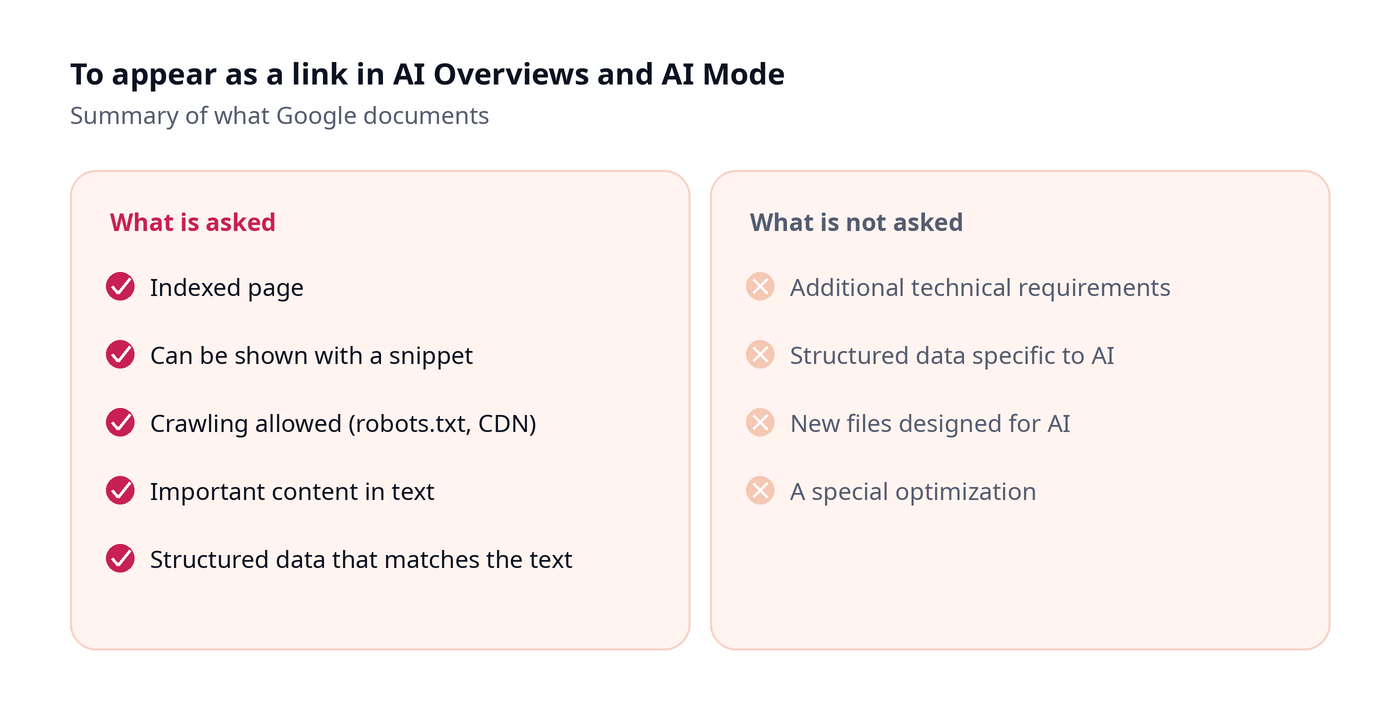
In short: No special optimization is needed to show up in Google’s AI answers. Google asks that the page is indexed, can be shown with a snippet and follows the usual SEO best practices: useful, crawlable and well-structured content.
AI Overviews and AI Mode: what we are talking about
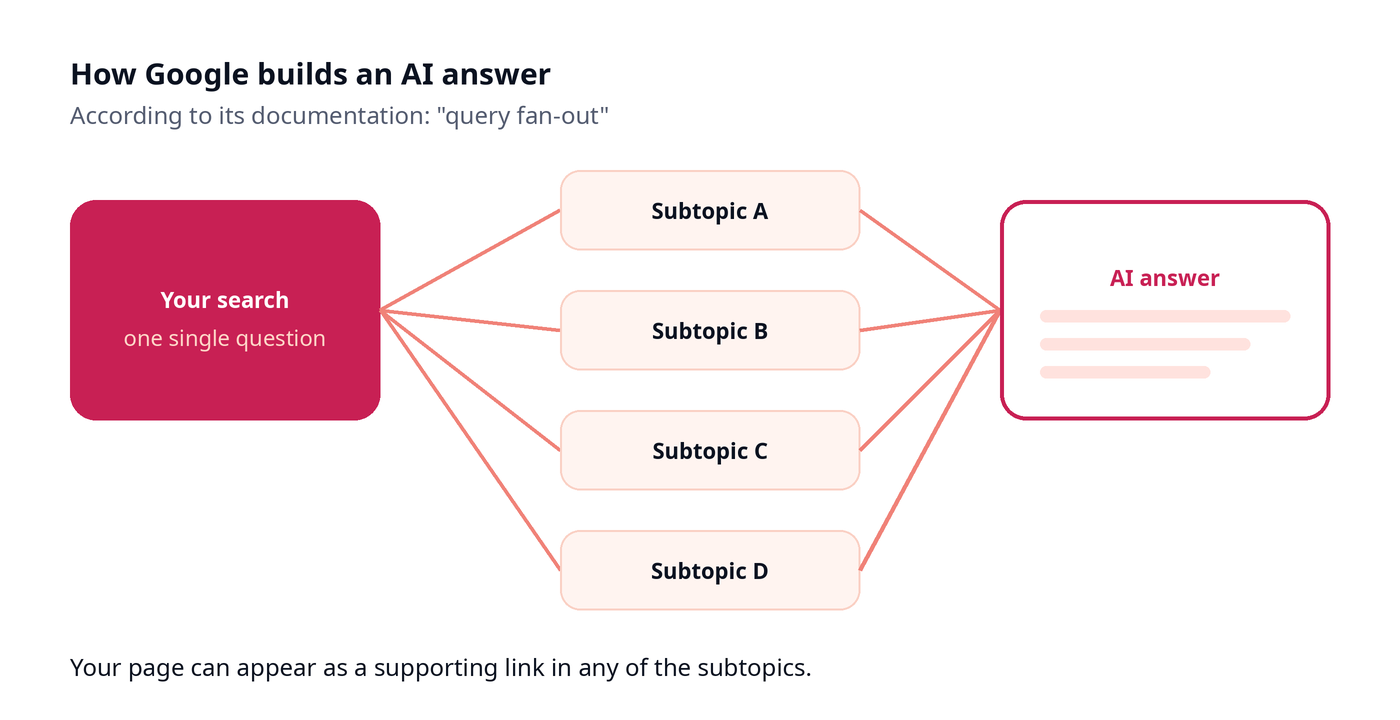
Two names that get mixed up. AI Overviews are the summaries that appear above the results for some searches. AI Mode is a different experience, for longer questions, comparisons or topics that require reasoning. Both can use what Google calls “query fan-out”: they don’t just answer what you typed, they launch several searches on subtopics and build the answer from what they find across all of them.
That last point seems to me the most important of all, because it changes the question. It is no longer just about ranking a page for a keyword. It is about your content solving one of those subtopics well.
“You have to do GEO, it’s a different discipline”
The documentation says the opposite. To appear as a supporting link, the page has to be indexed and be able to show with a snippet in Google Search. There are no additional technical requirements. It doesn’t ask for specific structured data or new files designed for AI. It talks about the usual things: allowing crawling (also on the CDN and the hosting), good internal linking, good page experience, important content in text, quality images and video, and structured data that matches what is visible.
My take: if someone sells you a new discipline, ask them to explain what it does differently from good SEO. If they can’t, it probably does nothing different.
“AI Overviews show up on every search”
No, that’s not true either. Google says they are only shown when it considers they add something to the classic search, and that on many queries they are not triggered. It seems like a small detail and it isn’t. A lot of the “SEO is dead” talk comes from treating all searches as if they had a summary. If you are going to measure anything, separate the searches with a summary from the ones without. Otherwise you compare different things and draw conclusions that aren’t real.
“If I show up in Google’s AI, I show up everywhere”
Here is a nuance that is almost never told. AI Overviews and AI Mode can use different models and techniques, so the links they show vary. Being cited in one doesn’t guarantee being cited in the other. When someone shows you a screenshot of “we are in Google’s AI”, the useful question is in which of the two, and for which search.
“It’s no longer worth writing content”
It’s the opposite, but with a condition. If what you write can be written by anyone, or can be summarized by an AI in three lines without losing anything, you have a problem. That problem already existed before, it just shows more now. If you write with your own judgment, with a concrete example or a defensible opinion, and on top of that the page solves a subtopic well, you have more chances of being cited, even if your site is small. Google says in its own documentation that these features allow more types of sites to appear. For those who work their content well, that is good news.
How I would write an article with all this in mind
Without tricks, there is a way of writing that serves the reader, Google and any AI that summarizes. Start with the short answer, in two or three sentences, and develop it afterwards. One subheading for each question the reader would really ask, in their words and not the specialist’s. Paragraphs that make sense without reading the rest. A short list of frequently asked questions at the end. And cite where each important fact comes from, with the author and the update date in view.
It is not writing for a machine. It is writing for someone in a hurry who wants to know if the page is useful to them. If a person in a hurry understands it in ten seconds, a system that launches several searches and picks fragments is likely to understand it too.
What I would measure and what I would not
Measuring is where it is easiest to fool yourself. Analytics tools group traffic in ways that don’t always distinguish whether there was an AI summary or not, so any figure shown without that nuance has to be read carefully. I would ask myself three simple questions: which pages get visits from searches, which have stopped getting them, and whether that matches the queries where Google usually shows summaries. That shows whether the problem is the change in search or simply content that was no longer the best.
What I would not do is trust a one-off screenshot. AI results change with the search, the moment and the model, and a screenshot is a photo of an instant, not a trend. If an agency report relies on three screenshots, it is not a report.
“Good” content should also be defined before you start. For me it is the content that answers a specific need better than what already exists, and that leaves whoever reads it with no need to search again. If you can’t explain in one sentence why your page is better than the others, it is hard for Google or any other system to see it.
What I would touch on a website, in order
- The basics: important pages indexed, a robots.txt without unnecessary blocks, a site that loads well on mobile. This is where most sites fail, and without it nothing else matters.
- The most important content, rewritten with your own judgment and a clear structure.
- Honest measurement, separating searches with and without a summary.
And an uncomfortable question for any SEO agency or supplier: “what do you do for AI that you don’t already do for regular SEO?”. A good answer starts with the basics and the content. A bad one sounds like a new product.
Frequently asked questions
Do you have to optimize the website in a special way for AI Overviews and AI Mode?
Not according to Google. There are no additional technical requirements or specific structured data. The usual SEO best practices apply.
What does a page need to appear as a link in a Google AI answer?
To be indexed and be able to show with a snippet in Google Search.
Does appearing in AI Overviews guarantee appearing in AI Mode?
No. They can use different models and techniques, and the links they show vary.
Where all this leaves me
I come from the marketing side and this sounds familiar. Every time the way traffic arrives changes, a trend with a new name and an invoice attached shows up. What has always worked is the least flashy thing: understanding what the person is looking for and answering them well. It is a real change in how traffic arrives, but it is not a change of rules, and I think that is better news than it seems.
If you want to talk about it applied to your case, here is my page on digital marketing services. And what you do with the visits that do arrive also counts: I already wrote about how to improve your conversion rate with CRO and about how to design a digital marketing plan.