

79
/ 100
SEO score
Creating a Digital Marketing plan is an advantage for your business because it lets you coordinate strategies at the right time.
It is vital in an environment as dynamic as the digital one, since it is very competitive and you need to know what to do on each channel. That is why it is important to define what you want, how, and to plan it with specific actions at specific times to reach the goals you want.
What is a Digital Marketing plan and why do it?
A Digital Marketing plan is a document that sets out the goals the company wants to reach in the short, medium and long term. It also designs the way and the type of actions to carry out to reach those goals.
The digital marketing plan should not be more than 5 pages long and should show:
- The current situation of the market and the company
- The goals you want to reach in a given time
- Planning of the actions to reach them.
This document should not be rigid and can be modified according to the chosen strategy so it can improve.
One of the situations in which the marketing plan must be flexible is:
- Launch of a new product / service.
- Corporate restructuring.
- Change of philosophy.
- Reputation.
- Business growth.
- New business lines.
- Adapting to a change in the sector.
As you can see, there are many variables that can make your digital marketing plan undergo periodic changes compared with the initial one. Knowing what they are will help you create a more effective one.
Benefits of the Digital Marketing plan
The main advantages are:
- Vision: You get a complete summary of the market, the competition and the current situation.
- Target audience: It lets you detect your potential users by knowing how they behave and their reasons.
- Planning: It lets you organize everything you are going to do in an orderly and structured way.
- Adaptation: By measuring the actions carried out, you can check whether it works and, if not, react accordingly.
The Digital Marketing plan can be created at the general company level or at product/service level. In the end, what matters is to define the actions and strategy to reach the goals of potential customers.
Never forget that you cannot base your Marketing plan on your products/services. The user must be at the center of everything and you must act accordingly. If you do it the other way around, you will surely fail.
Steps to make a Digital Marketing plan
1) Market analysis
What you must do is analyze the current situation of the sector, the competition and where we stand.
In this section it is important to detect what our target audience really needs, in order to go straight to it with what they need.
The first premise you must always be clear about in your Digital Marketing plan is that you must help your potential customer with your service or product. This way you will succeed.
How to analyze the market?
To research the state of the market objectively, there are different tools that can help you, such as SEMrush or Buzzsumo.
With these apps you will get valuable information about searches or intents, competitor positioning, keywords, publications… so you can better understand the audience you want to reach and, above all, know what your competition does.
2) Analyze the competition
Once we have analyzed the market, now let’s go for the competition.
The goal of this study is to get to know your competitors, know their weaknesses, brand status, strengths and positioning. In short, to have all the relevant information so we can position ourselves better than them.
What should you know?
- SEO positioning in search engines.
- Number of followers on social networks and their evolution.
- Average engagement on social networks: likes, retweets, comments, etc. (Buzzsumo will give you this).
- Average engagement on their website: social shares and comments (use Sharedcount).
- Ranking on the internet (with Alexa).
In the end, what you must get is all the information you can reach, so you can make concrete decisions in your Digital Marketing plan.
3) Analyze your current situation
Before starting this section of your Digital Marketing plan, you must be clear about where you are. For this you should keep in mind the following metrics:
- Alexa ranking.
- SEO ranking.
- Backlinks.
- Monthly visits.
- Page views.
- Acquisition channels.
- Traffic sources: organic-referral.
- Search results.
- Keyword positioning.
- Evolution and engagement on social networks.
- Heat maps and content analysis.
- Knowing who has talked about you and how.
- Comments and reviews on other services…
Once you have everything organized in a spreadsheet, you can extract a SWOT of the market, the competition and your current situation, to get your Weaknesses, Strengths, Threats and Opportunities.
4) Create your SWOT
The SWOT is summed up in the following four words:
- Weaknesses: Internal drawbacks you have.
- Strengths: Aspects that set you apart from your competition.
- Threats: What your competition has that can hurt your business.
- Opportunities: The differential value that can get you to your goal.
Having the SWOT done is very important to know yourself and your business and to face the challenges with perspective. This is fundamental for your Digital Marketing plan.

5) Define your potential user
This section is very important in the Digital Marketing plan. Let’s see how we do it:
Definition of the target customer or buyer persona
The purpose of all this is to create a fictional portrait for our Marketing plan that helps us keep in mind the type of customer, their behaviors, hobbies, way of life… so we can understand them better and know how to reach them in the most natural way possible.
What should you take into account to define the perfect user?
- Behavior: how they interact with your service/product and where.
- Interests: hobbies, what they spend their time on.
- Demographics: age, gender, education and job.
- Ambitions: what they aspire to.
- Content: how they consume information.
- Searches: which keywords they use to find you.
- Purchases: what they buy, where and how many times.
- Needs: what need you can cover for them.
- Obstacles: what problems they have in taking the desired actions.
Create a template with first names, last names, story, goals and challenges, with a professional environment and the current situation of your ideal customer.
What is the Customer journey?
It is a model that lets you know the behavior, needs and problems of the target audience during the buying process.
You may be interested in: Customer Journey: design the best experience for your customer.
6) Set the budget
Now we must create the budget. It is fundamental to know how many resources you have to carry out the different actions.
My advice is that it is better to overestimate than to fall short, since unexpected costs or corrective actions you had not considered can always appear.
What you must take into account to create your Digital Marketing budget
- Licenses for tools and material to use.
- Hiring qualified staff: community manager, developer, graphic designer, etc.
- Advertising: Facebook ads, Google Ads, etc.
You may be interested in: Remarketing. Create campaigns in Google Ads and Facebook Ads
7) Create the proposal
Now comes the real meat. With all the information gathered before, we only need to define the goals and the strategy to reach them. Let’s start with each one:
Define the goals
To set your goals you must follow the SMART rule, which says your goals must be:
- Specific.
- Measurable.
- Achievable.
- Realistic.
- Time-bound.
Define the strategy
After the goals, let’s define the strategy and actions in the Digital Marketing plan, which must always be aligned with the goals, such as:
- The business goals or what you need.
- The Marketing goals or how to get what you need.
- The strategies to reach them.
- The actions to carry out the goals.
A real example of Digital Marketing plan goals would be:
The actions aim to get more traffic to your website and to get a conversion to obtain the desired userGoals:
- Increase website traffic by 20%
- Get 1,300 followers on Instagram in 6 months.
- Reduce your website’s bounce rate by 12%
- Increase time on the website by 1 minute
- Get between 700 and 1,000 subscribers in 6 months
- Increase online sales by 35%
How can we achieve it?
To reach all the set goals we must take into account the following parameters:
- Reach: Get to the audience.
- Attraction: Give reasons to visit our website.
- Conversion or leads: Get the audience to take the desired action, such as subscribing, buying…
- Profit: Manage to earn
- Captivate: Win your users over so they come back.
How to make the strategy?
With all the goals specified, we will create the strategy and actions to reach them.
The strategy of your Digital Marketing plan must lead to reaching our goals. To make it easier, let’s do it with an example:
If your goal is to increase your followers on social networks, we must take the following actions to reach your goal:
| Goal | Strategy | Action |
| Increase by 1,300 followers on Instagram. | Create giveaways for Instagram. | Announce it through Instagram… |
| Create interesting and viral content on related topics. | Create informative and entertaining content that can become viral. | |
| Offer special discounts to followers. | Offers and discounts only for followers. | |
| Create advertising campaigns to get followers | Create campaigns to attract new fans with Facebook Ads. |
In short, it is about defining a goal and seeing how we are going to do it.
Goals will vary during the evolution of your project, but if you are clear on how to define them it will be much easier.
It is important that everything is traceable so you can evaluate the actions and draw conclusions accordingly.
8) Define the promotion phases
Now you must set up the strategy of your Digital Marketing plan to promote your products/services and know whether they work.
You must define promotions for each type of channel, since the way of interacting and consuming content is not the same between them.
You may be interested in: Create your Facebook strategy: steps, types and ways
An important detail is to define the posting frequency you will have on social networks, blog and other sites, to know how much you will invest in advertising.
My recommendations on frequency (more or less):
- Blog: 2 posts a week
- Facebook: 2 pieces of content a day
- Twitter: 5 tweets a day
- Instagram: 1 piece of content a day
- LinkedIn: 1 piece of content a day
And the type of content should be:
- 40% promotion
- 10% contests
- 20% branding
- 30% offers
9) Measure and evaluate the actions
We enter the final phase, the one that tells us whether our Digital Marketing plan works or not.
This phase is fundamental to evaluate all the work done.
Because if we cannot measure the impact of our actions, we will not know whether our Digital Marketing strategy has been a success.
To know what to improve, we must know what to measure and which KPIs to measure, and follow them frequently (weekly, monthly…)
KPIs for website or blog
- Percentage of visits.
- Page views.
- Bounce rate.
- Abandonment rate.
- Average session duration.
- Most viewed pages of your website.
- Audience: age, gender, location.
- Actions taken: purchase or subscription.
- Number of subscribers.
- Number of sales.
- User journey through the site.
Social media KPIs
- Post engagement: shares, favorites, likes.
- Average reach of organic posts.
- Average reach of paid posts.
- Increase in the number of fans.
- Time and day with the best posting data.
- Clicks on the call to action.
SEO KPIs
- Overall position of your website in the SERPs.
- Number of ranked keywords.
- Backlinks.
- Domain authority.
Brand KPIs
- Social mentions.
- Recognition.
Depending on the type of KPIs, I would say you should give yourself a certain time margin to see results. For example, SEO does not start to show until after 6 months, and others, like the website, need a couple of months to have enough volume of metrics.
You may be interested in: 3 Digital Marketing strategies: Content, Trends, Influencers
Tools to create a Digital Marketing plan
To finish, here are some services that can help you make your Digital Marketing plan.
- Excel: to collect and organize data
- Keyword Tool.io: is ideal for keyword and long tail search
- SEMrush: perfect for keyword research and competitor monitoring.
- Google Data Studio: builds your automated dashboards from different sources such as Google Analytics or a spreadsheet.
- Alexa: a tool that measures the visibility and popularity of a site.
- Answer The Public: gives clues about long tail searches users make.
- Buzzsumo lets you know which posts are the most shared on social networks.
- Ahrefs: helps find the most relevant content by keyword.
- Similar Web: analyzes both the web traffic and the web apps of your competition.
- Sistrix: gives you your competition’s visibility index and the most relevant SEO data.
- Moz: shows the authority of a domain.
- Rivaliq: generates social network audits and analyzes behavior, influence and reach data.
- Metricool:manages, plans and measures social networks and blogs.
- Google analytics: gathers all the analytics data of your website or app.
- Twitter Analytics: you get Twitter statistics
- Facebook Analytics: offers traffic and behavior data on Facebook.
- SiteAlerts: monitors your competition, conversions, traffic…
In summary
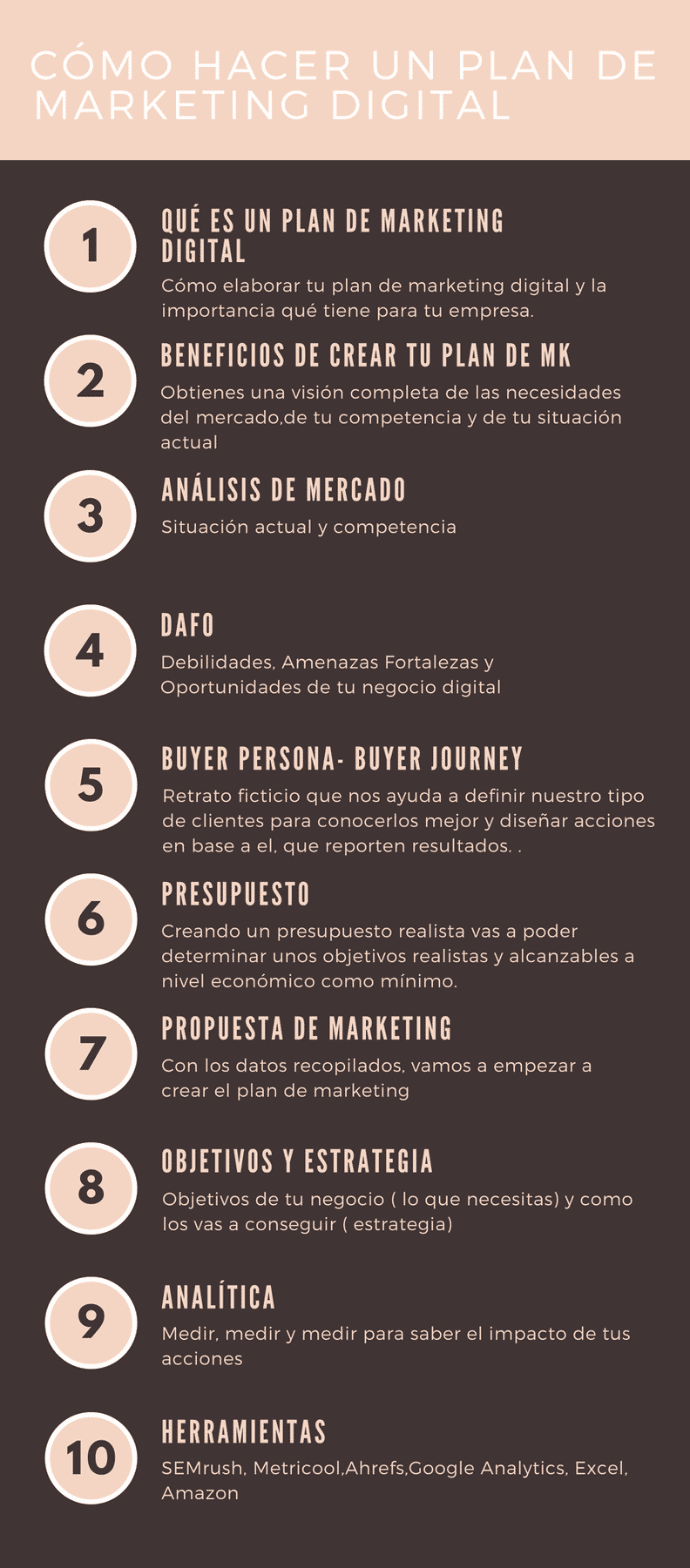
Here is an infographic that gathers all the information and will make everything clear.