
83
/ 100
SEO score
Whatever your business is, what you must always be clear about is that the customer must be at the center of your whole product or service. So it is very important to know them, because afterwards a series of customer-oriented actions will be carried out to get more sales. This is done with the Customer Journey 🙂
What is a customer journey or customer experience map?
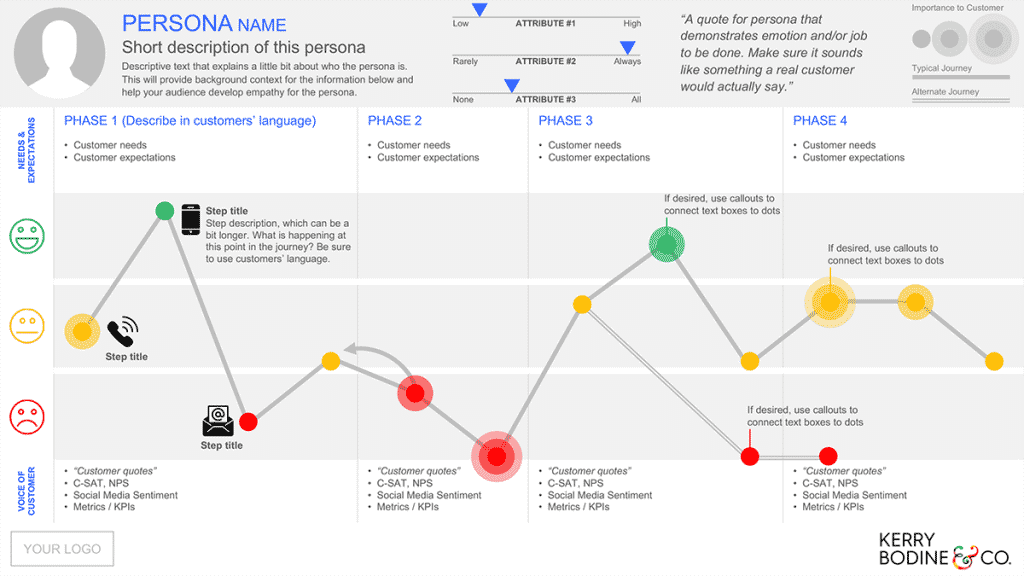
Customer journey is a diagram that describes a customer’s interactions with a business from the initial attraction phase to the loyalty phase.
The goal is to find a way to empathize with the customer, to know how to meet their needs at each stage they are in, and to know the actions and the way to interact for that moment.
How to create a Customer Journey?
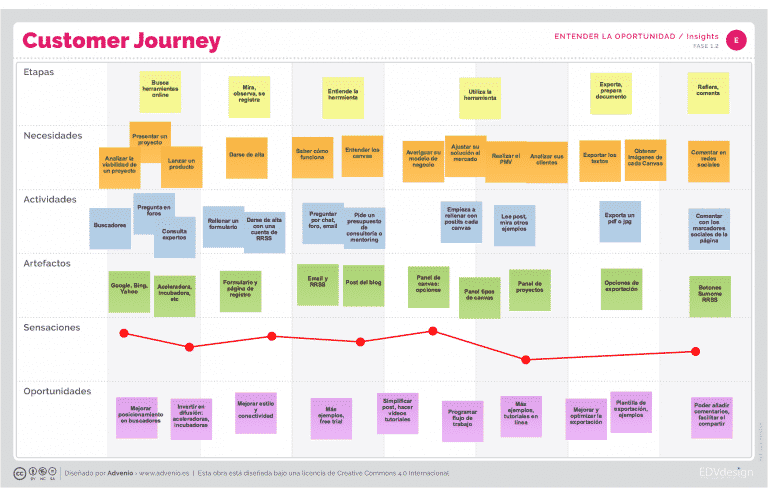
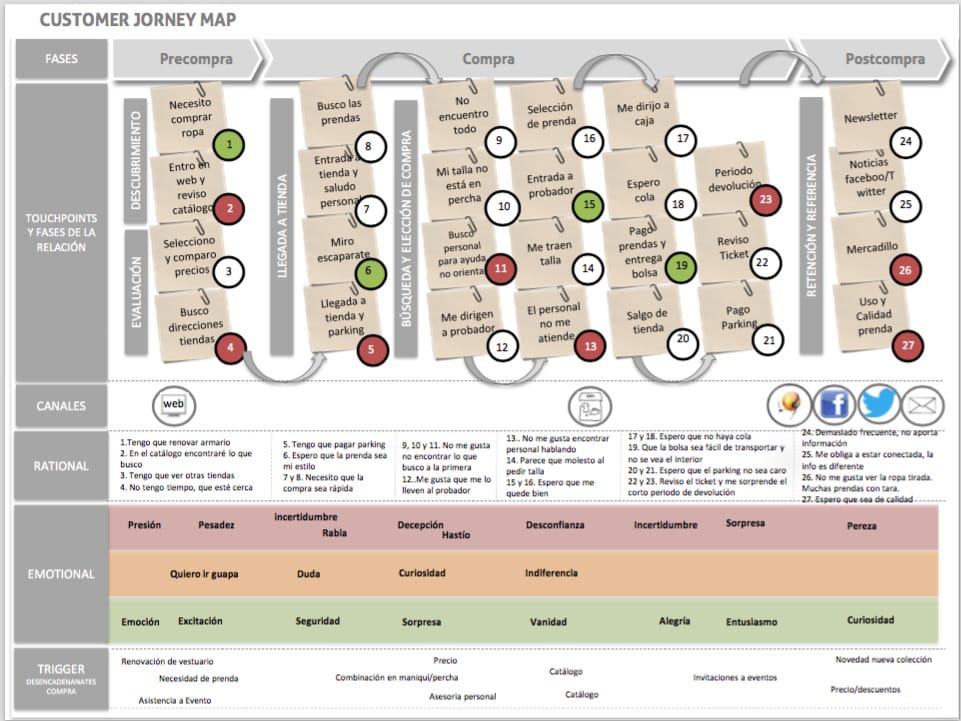
The customer experience map lets you design the Customer Experience, in which your business strategy will interact with customers, and all of this is seen in a very visual way.
The customer journey will help you to discover which are the best actions for each type of customer to: attract, convert and retain. To make sure your sales increase.
To do all this you must rely on the metrics of your online service or product, because with a good experience you make sure to:
- Increase engagement and loyalty to your product/service by x5.
- Increase purchase intent by around 30%.
How to design my Customer Journey
To design your customer experience map we will divide it into 4 big steps:
1) Research
The first job is to know who our target audience is and profile it very well, to know who they are and get to know them as if they were our best friend. This is important to build our buyer persona.
As I say, this point is very important: knowing which type of customer our product or service will go to, because if we get it wrong, the user experience we design will be useless.
To do this customer profiling we have two alternatives:
Quick option
If you are one of those people who don’t have the time or money to go out and interview anonymous people, maybe this is your option.
The way to get to know your customers is through the behaviors and opinions they share on social networks.
To do this you must know well which social networks to go to. For example, if your business model is aimed at the end customer you should go to Facebook and Instagram; if it is aimed at companies, to Twitter and LinkedIn.
Once you are there you must keep in mind a series of questions that your type of customer has to fit, such as:
- What do they like?
- What are the things they don’t like?
- What do they share on their social networks?
- Are they active on social networks? Which ones?
- Who are their friends?
Perfectionist option
If you are one of those who believe studies should be done on well-built foundations, this is your option. You will have to do interviews, focus groups… to really find out who they are and what their needs are.
There are many types of customer interviews and surveys. But one that may interest you is the so-called Jobs to be done interviews by Clayton Christensen. It is based on the idea that customers don’t know what they want and that the only way to find out is by observing their behavior, since otherwise they may lie to you.
The questions must be designed to find out:
- How they discover a problem that your customer may not know they have
- How they talk about the problem.
- How they interact: functionally, emotionally and socially speaking
- What they expect to get.
- Constraints.
- Where they look for information
- Who their brands or influencers are, whom they expect to solve their problem.
- Why they choose a particular product.
- Does the product or service used meet their expectations?
- If they recommend the product: how they do it, what they say…
- What complaints they have
2) Defining the buyer persona
Once all the information from the research phase has been collected, we are going to summarize it and order the ideas so that we have a real picture of our type of customer for the Customer Journey.
To do this we use a buyer persona, taken from inbound marketing.
A buyer persona simplifies the uniqueness of each customer into a single profile that sums up the most important traits of our ideal customer and, at the same time, defines the ideal person to work with and empathize with.
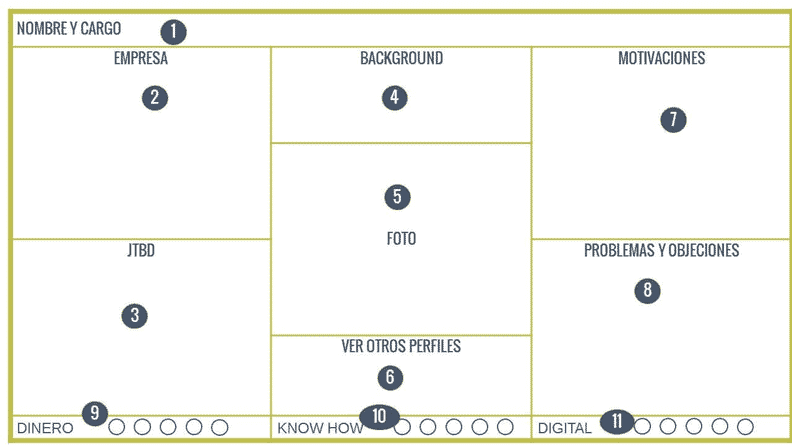
The buyer persona has 11 sections:
- Name and job title
- Company: the type of company our persona works for and its information such as:
- Revenue,
- Sector
- Number of employees
- JTBD: jobs and problems they have, and which of them you can solve with your service or product.
- Background:
- Age
- Education
- Whether they have children or not
- Hobbies and interests
- Photo of the person: a real photo of the person helps a lot to identify that type of customer.
- Other profiles: whether you have more than one type of customer, such as:
- Buyer
- Influencer
- User
- Seller
- Motivation: why they buy or use our product or service.
- Objections and problems: what the customer has regarding our product or service.
- Price: barrier to entry when deciding to use the product
- Knowledge: what that person knows about the product or service you offer.
- Digital: Define whether they use social networks, consume digital products… or the opposite.
3) Deciding the phases of our customer journey
Now that we have our user or customer defined for our Customer Journey, we are going to define the moments and also the phases in which we will interact. That is, we have to define our sales funnel.
If you don’t know how to develop it, here are some examples:
Inbound marketing
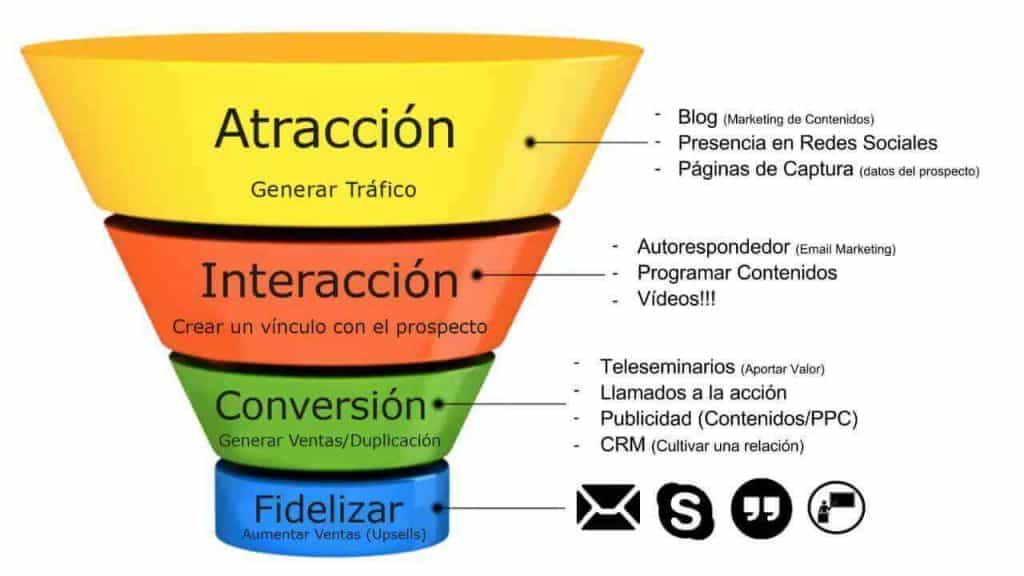
In inbound marketing the sales funnel has 4 phases:
- Attract
- Convert
- Close
- Delight.
Double conversion funnel
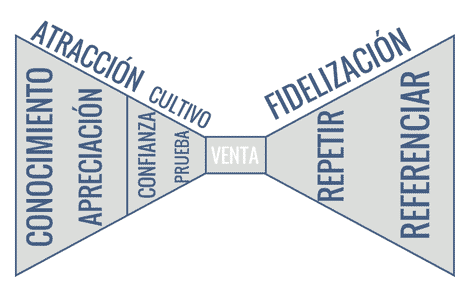
Buying process from the customer’s point of view:
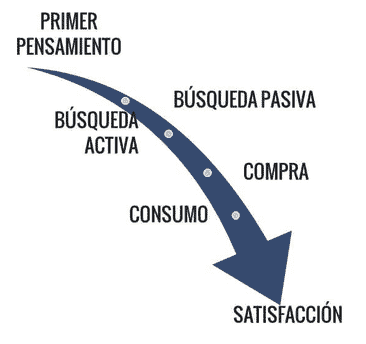
- First thought: “I’m not clear what problem I have”
- Passive search: “I’ll look out of curiosity to see if any solution exists”.
- Active search: “I’m clear about what my problem is and I want to solve it”.
- Consideration: “I’ve selected 2 or 3 options and my decision criteria”.
- Compare: “I choose one option; I pay”.
- Consumption: “I use the product or service”
- Satisfaction: “I check whether it has solved the problem”.
Sales funnel
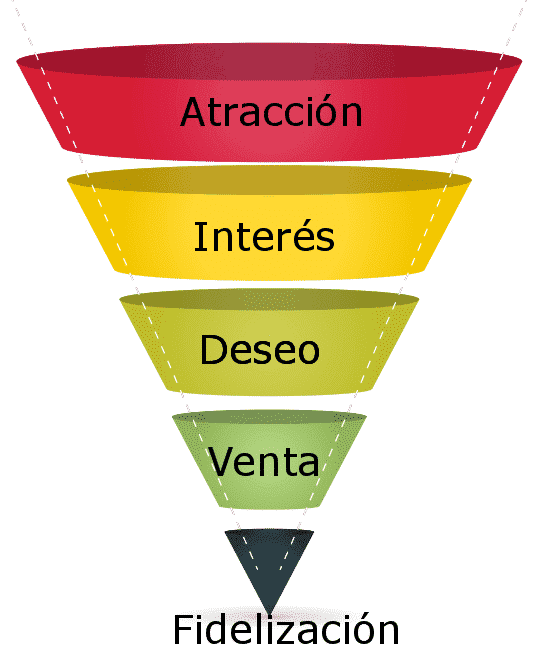
- Attraction: Get the customer to find your service or product. You can do this through blogs, social networks, events…
- Interest: Convince the customer that you are their best option compared with the rest.
- Desire: Create in the customer a pull that creates the need to choose you.
- Sale: Make the sale to the customer.
- Loyalty: Get the customer to buy from you again and speak well of you to family and friends.
4) Brainstorming
With the customer profiling and the phases of actions defined for your Customer Journey, you have to see the actions a customer has to take in each of the stages.
At this point we are going to generate creative ideas that will be defined in the future.
5) Create our Customer Journey
We have reached the final stage. Now we are going to create our customer experience map.
We will do it based on the following template:
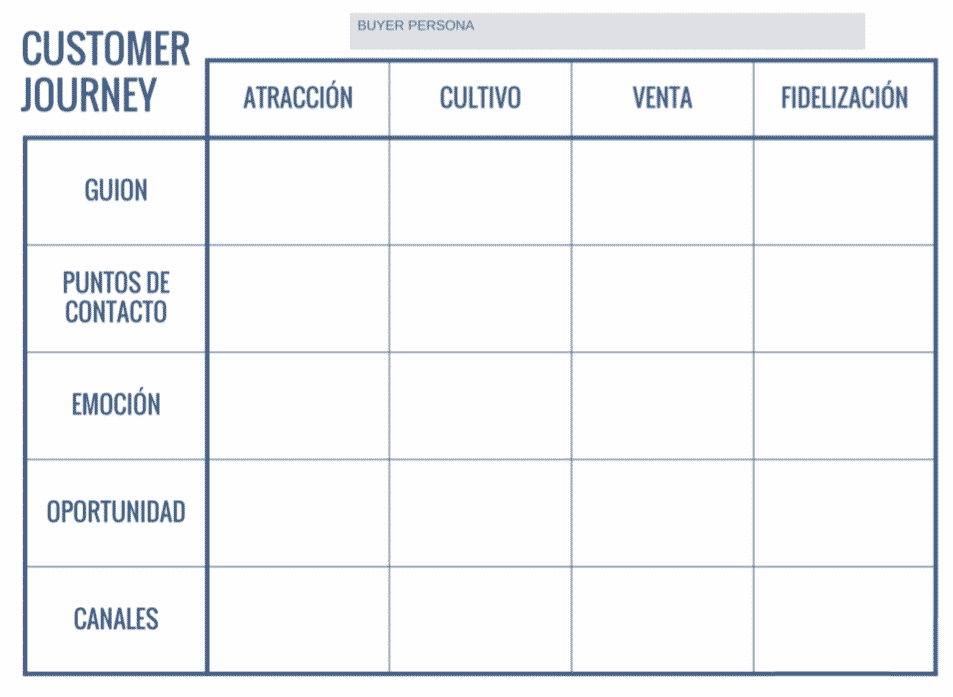
DOWNLOAD CUSTOMER JOURNEY TEMPLATE
We start with the row:
- Attraction: the customer has a problem and looks for the best possible solution. Our goal must be to collect their data to stay in touch and so they ask us for information.
- Nurturing: They evaluate the options they have already found. The goal is to get them to decide on us.
- Sale: The sale of the good or service takes place
- Loyalty: the customer has already used our product or service and we find out whether they are satisfied with the service provided. It is important to convince them to consume other products or services of ours, or to recommend us to other customers.
Now we must empathize with the customer in each of those phases to build a unique experience. We must keep in mind:
- Script: What has happened to the customer to be in this situation?
- Touchpoints: What forms of contact do we have with the customer?
- Emotion: How do they feel, what is their emotional state?
- Opportunity: What actions can we take to get ahead of the customer’s needs?
- Channels: Which contact channels will be used to carry out the actions?
And now what do you do with your Customer Journey Map?
We have done a huge job summing up in a very visual way the whole Customer Journey, although surely once it is done you ask yourself: and now what do I do with this?
Well, congratulations, you now have in your hands your marketing and sales strategy, and without realizing it you have also defined your products or services, since your Customer Journey tells you:
- Attraction strategies for your customer.
- What type of actions to carry out.
- The best way to close a sale.
- What you need to take care of so the customer speaks well of you and buys from you again.
- How to make your product or service more attractive to your customer.
Important
In short, don’t forget to be clear about who your customer is and to detect the moments where your product or service can have the greatest impact on that customer’s experience, and so give them what they really need.
Examples of Customer Journey
Here are some Customer Journey examples you can use: