
81
/ 100
SEO score
Everyone has heard of customer engagement in a business. So below we will explain what customer engagement is and how I can really measure it now.
What is the definition of engagement?
Like most definitions, it depends on who you ask. Here are my favourites.
The ongoing interactions between company and customer, offered by the company and chosen by the customer. – Paul Greenberg
What it says is that it includes the customer in the choice to interact with the brand. That is why “Win a Free iPad” promos should not count towards engagement, or at least should be counted as a lesser form of the participation of a voluntarily engaged customer.
Engagement is an estimate of the degree and depth of visitor interaction against a clearly defined set of goals. – Eric Peterson
This is the definition I like most because it alludes to the fact that engagement can have a magnitude. In simple terms: certain engagements are more engaging than others. While a tweet and a video testimonial are both forms of engagement, the video testimonial is certainly a sign of more engagement.
However, what I disagree with is that I do not think you need a set of goals in order to have customer engagement; in my opinion it is already happening whether you are measuring it or not.
With all this, the most accurate definition is:
“Customer engagement is the degree and depth of customer-centred brand interactions the customer chooses to carry out.”
Why should you care about engagement?
This is much more obvious to anyone who frequents business blogs, LinkedIn discussions or conferences.
But customer engagement is really a concern for many businesses. It is not just buzz. In a June 2014 study published by McKinsey & Company, titled “The digital tipping point”, C-level executives said customer engagement is the top strategic priority for digital business initiatives.
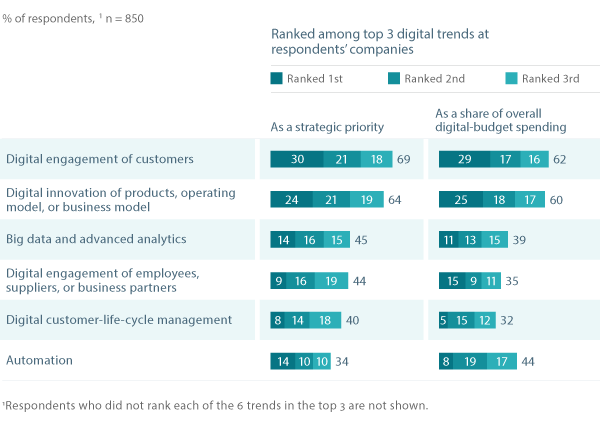
This is clearly a priority for decision makers in an organization, but why? The link between a customer’s satisfaction and profit has existed for quite some time, but the data on all customer engagement is still being worked out.
There are some studies such asHall and Partners’ “Engager” modelwhich shows that up to 2/3 of a brand’s profits can depend on effective customer engagement.
Ray Wang, atConstellation Research states that
… they see companies that have improved cross-selling engagement by 22%, raised car sales revenue from 13% to 51%, and also increased order sizes by 5% to 85%.
Is a customer’s engagement correlated with customer loyalty?
Yes. Aimee Lucas of the Temkin Group states that
Customer engagement is highly correlated with customer loyalty.
This is intuitive; customers who are more engaged with a brand should be more loyal.
How to calculate your eCommerce customer engagement?
It is often overwhelming when you think about all the ways customers can engage with an ecommerce brand:
- Registered customer accounts
- Purchases
- Social media actions
- Net promoter score
- Page views per visit
- Number of visits per year
- Email open rate
- Submitting user-generated content…
Collecting dozens of all these measures and trying to assess overall customer engagement is hard. Instead of looking at all these components of customer engagement, the best approach is to combine them all into a single metric. This will give a single value, making the metric easy to understand and the analysis easy to show relative changes in customer engagement.
There have been several ways to do this, but the one I like best by far is Eric T. Peterson’s. His method means that if a certain component metric of the formula is of no use to us, it can simply be removed and the metric will still be usable. Although I am not going into the details of calculating this indicator, here is his formula, and here is a full blog post on how to calculate customer engagement using this formula.

In short, a customer’s engagement score is the sum of their:
- Click-Depth Index (Ci): is the percentage of sessions that have more than “n” page views, divided by all sessions.
- Recency Index (Ri): is the percentage of sessions that have more than “n” page views that occurred in the past “n” weeks divided by all sessions. The Recency Index captures the latest sessions that were also deep enough to be measured in the Click-Depth Index.
- Duration Index (Di): is the percentage of sessions longer than “n” minutes divided by all sessions.
- Brand Index (Bi):percentage of sessions that begin either directly (that is, with no referring URL) or by an external search for a “branded” term, divided by all sessions (see further explanation below)
- Feedback Index (Fi):is the percentage of sessions where the visitor gave direct feedback through a voice-of-customer technology such as ForeSee or OpinionLab, divided by all sessions (see further explanation below)
- Interaction Index (Ii): is the percentage of sessions where the visitor completed any one of the specific tracked events, divided by all sessions (see further explanation below)
- Loyalty Index (Li): scores “1” if the visitor has come to the site more than “n” times during the timeframe being examined (and otherwise scores “0”)
- Subscription Index (Si): scores “1” if the visitor is a known content subscriber (that is, subscribed to my blog) during the timeframe being examined (and otherwise scores “0”)
The only criticism I have of this model is that it does not use purchase data.
Final recommendation
My recommendation would be to do the following:
- Determine what forms of engagement you have with the customer and their data.
- Build your own custom metric adapted to your business needs.
- Include the customer engagement score with the KPIs so you can produce reports.
- Correlate your customer engagement with your profit. Use regression as well as cohort analysis. Regularly compare the two metrics until you can see a correlation, even if this correlation lags (that is why cohort analysis is important).
- Refine your metric until it is reasonably correlated with your profit.
- Justify the investment in customer engagement, since it is directly related to your profits. Always create loyal and happy customers, they are the profitable ones for your business.