
76
/ 100
SEO score
Inbound Marketing makes potential users proactively come to your products and services. In short, it is about offering value in a non-intrusive way, trying not to make users feel “harassed” by advertising the way they do with traditional advertising. With inbound marketing techniques, users come to the online service, and unlike with outbound, you are not the one who has to find them. The difference between the two is that in the first the key is creating quality content and in the second, the budget allocated to it.
Phases of the inbound marketing methodology:
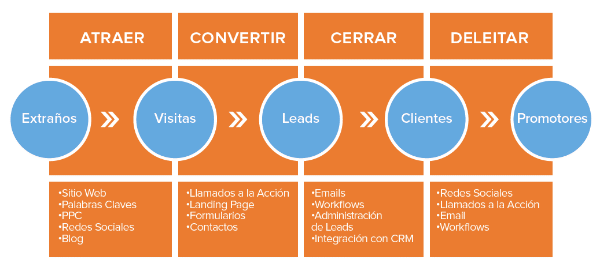
- Attract: To make users come to your site, you must use different strategic actions such as content marketing, SEO, social media, PPC, etc. It is important that you do it according to a strategic plan to get effective and desired results.
- Convert:You must apply all the necessary techniques in order to turn traffic into a database so that your inbound actions are effective. Landing pages, calls to action and forms can be very useful.
- Close: Once you have your database, you must manage the records and integrate them with a CRM or with automation and lead nurturing tools. This creates an automated content flow adapted to the user’s buying cycle, related to lead scoring, which determines the right moment to turn them into a customer.
- Delight:With enough data collected from your users and having studied their behaviour, you must set a strategy based on the previous analysis so you can adapt to your customers and offer them what they need at all times.
Coordination is very important, so everything must be perfectly integrated.
You may be interested in
Inbound Marketing actions
- Content creation:Content (not only text but optimized landing pages, videos, etc.) must be created seeking to attract the target audience. Optimized content that answers customers’ basic questions and needs.
- Behaviour reading:You need to keep in mind that people go through different stages as they interact with your service, and each stage requires different marketing actions. As we learn more about customers we must tailor messages better to their specific needs.
- Virality: Social networks are the best place to practise Inbound Marketing, the ideal place to interact directly with our target. In this case I advise you to study social networks well, since not all of them may be useful for the type of business you have and you may make unnecessary efforts.
- Analytics: Essential to know whether the actions carried out end up converting. Inbound Marketing requires a very detailed analytics process in order to analyse user behaviour on the site, to help work out the profitability of products, identify which campaigns are working best, etc.
Inbound Marketing and its innovative spirit:
- Interact with your customers. They are the ones who have shown interest in you through relevant content. Try to understand their needs and offer them a product tailored to them.
- Novelty: Inbound Marketing offers qualified content and gives information on which buying stage the interested user is in.
- Branding:Boost your brand image through content of interest. You will project the image of a serious and reliable company in the market.
- Organization: Draw up a content publishing plan and find out which content may interest your target audience most.
- Unification: Look to carry out consistent actions across all channels, with a defined goal and timeframe based on a marketing strategy.
- Naturalness: try to find the most fluid and familiar communication for your target audience.
- Dynamization: Users will share that relevant content with other friends and this can bring potential customers if you use a good dynamization strategy.