

Personal AI agents: a chatbot answers you, an agent does the work and comes back when it is finished or when you need to decide. That is the difference that matters in 2026, and three products represent it well: Instinct, Grok Bot (from xAI) and Muse (from Meta).
Before comparing them, I explain what personal AI agents are and how they work, because the comparison makes little sense without it. Then come prices, a table of what each one does and does not do, and the rest: use cases, how to start and which one I would pick.
Disclosure: I use Instinct every day, including to prepare this article. I have not tried Grok Bot or Muse. What I say about them comes from their official pages and from independent outlets (The Verge, WIRED, InfoQ, Notebookcheck), linked at the end. About Instinct I report what its own website says and what the press has published, always with the source. When something cannot be confirmed in an official source, I mark it “not confirmed”. Muse is also not available in Spain for now, according to Notebookcheck, so I could not try it even if I wanted to. Personal AI agents data checked on October 14, 2026.
What a personal AI agent is
A personal AI agent is an assistant you give a goal to, and it carries it out. It does not stop at writing an answer: it opens the browser, fills in forms, sends emails, books or buys, and tells you when it is done or when it needs your permission.
The difference from a chatbot is simple. A chatbot tells you what to do. An agent does it, in the real tools. Meta puts it this way when introducing Muse: it does not just answer questions, it does the work. xAI frames Grok Bot the same way: digital teammates you message and who finish the work in the tools you already use.
This is what Meta and xAI document for Muse and Grok Bot, and it is what defines personal AI agents:
- It has its own computer in the cloud. Grok Bot describes it with a browser and terminal. Muse calls it Muse Secure VM. For Instinct, its website says it can use a phone and a computer the way a person would.
- It works inside your apps. Email, calendar, documents and other tools you connect.
- It keeps working after you close the app. It tells you when it finishes or when something changes.
- It asks permission for sensitive things. Sending an email or making a purchase should not happen without your approval.
How personal AI agents work
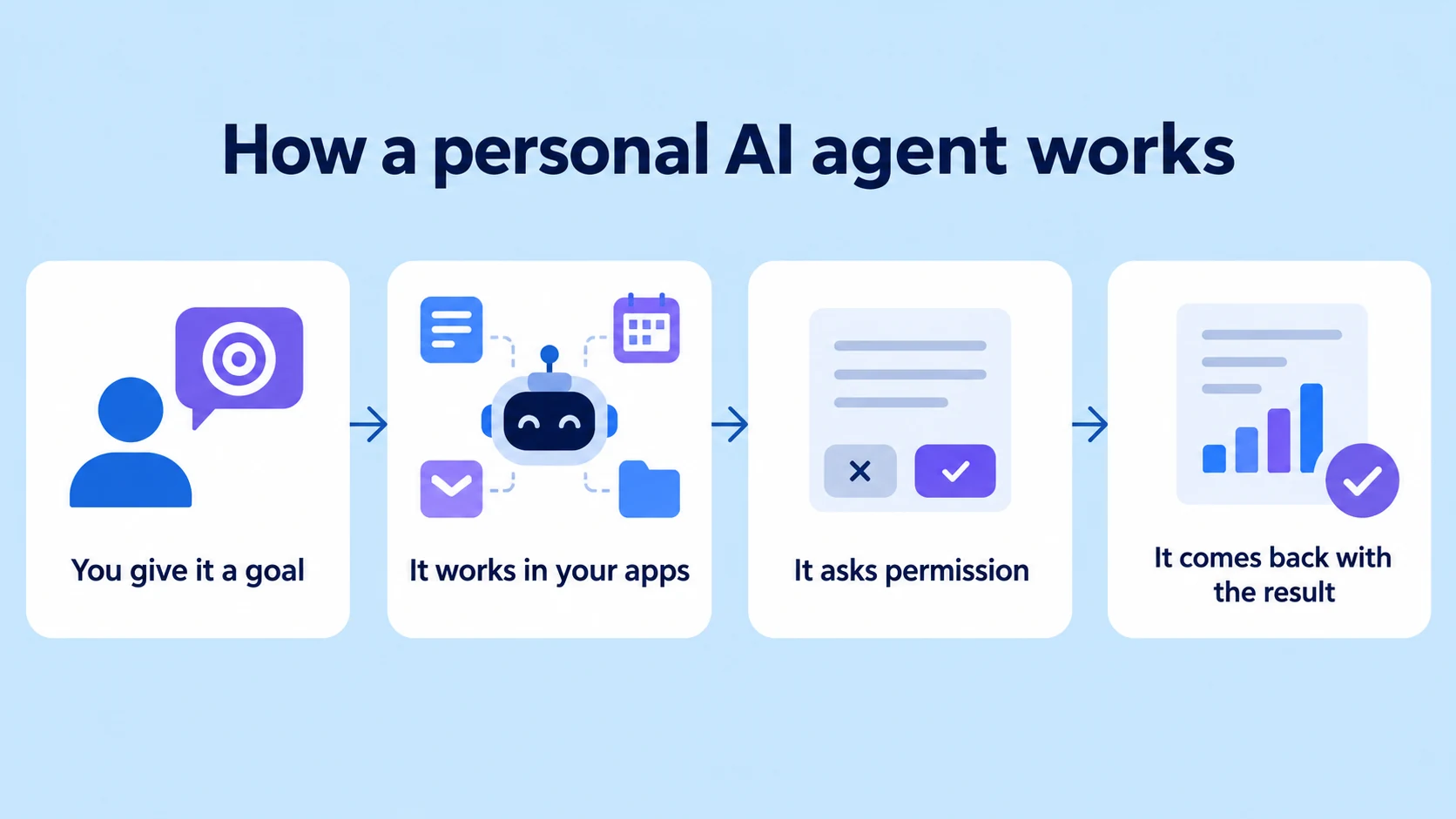
The cycle is similar everywhere, though the details change:
- You say what you need. By message, like to a person. The clearer the goal and the limits, the better it goes.
- It asks what it is missing. If something is unclear, it asks before starting.
- It works on its own. It goes into the apps you connected, opens the browser and moves forward step by step, even when you are not watching.
- It asks permission for sensitive steps. Before sending an email or paying, it comes back to you for approval.
- It comes back with the result. You review what it did, ask for changes or close the topic.
Each product handles this its own way. Instinct has no new interface: you message it on iMessage or WhatsApp. Grok Bot works as a message thread on mobile and desktop, and you can have several bots at once, each with its own role. Muse lives in an isolated virtual machine, and a second agent called Sentinel decides which actions and which outgoing connections are approved and asks permission when needed.
One tip that works for any of them: start with a small, reversible task and widen access little by little. An agent can reach your email, your accounts and sometimes your money. That trust is earned, not given. It applies to all personal AI agents.
Prices of personal AI agents
Swipe the table to the right to see all three columns.
| Instinct | Grok Bot | Muse | |
|---|---|---|---|
| Free plan | Not confirmed | No: Grok Bot is listed from the Premium plan | Yes, with a usage limit |
| First paid plan | Not confirmed | Premium: $30/month before taxes (The X Subscription, which bundles Grok, Grok Bot, Cursor and X Premium) | Power: $20/month (500M tokens per week) |
| Higher plan | Not confirmed | Super: $100/month (15x the usage of Plus). Ultra: $200/month (50x) | Max: $100/month (3B tokens per week) |
| How it is charged | Not confirmed | No price of its own: Grok Bot has its own usage, separate from Grok and Cursor | Monthly subscription, renews automatically |
Important notes:
- Instinct: I could not confirm any price, or whether it is free, in an official source. That is why I give no figure. Further down I report what The Verge published, as an attributed statement and not as a rate.
- Grok Bot: on October 12, 2026 xAI introduced “The X Subscription”, one plan with Grok, Grok Bot, Cursor and X Premium. xAI’s pricing page lists Grok Bot from Premium ($30/month). The older plans (SuperGrok, Cursor, X Premium) continue for people who already have them, but are no longer offered to new customers. Grok Bot is also included in paid Cursor plans, whose price I have not verified. Grok Bot usage is separate from your Grok or Cursor plan usage. According to xAI, prices do not include taxes such as VAT.
- Muse: Meta warns that benefits and availability may vary by region, and that subscriptions are in limited testing.
What each personal AI agent does and does not do
This table of personal AI agents collects what each company says on its official pages and, where I say so, what the press reports. “Not confirmed” does not mean it cannot do it: it means I could not check it in a reliable source, so I do not claim it.
Swipe the table to the right to see all three columns.
| Instinct | Grok Bot | Muse | |
|---|---|---|---|
| How you talk to it | On iMessage or WhatsApp (WIRED and The Verge) | Message thread in desktop and mobile apps | Mobile app, web (muse.ai) and WhatsApp |
| Acts in your tools | Its website says it can use a phone and a computer like a person. The Verge adds that it connects to Google Workspace, Slack and Notion | Yes: cloud computer with browser and terminal, signed in to your apps | Yes: opens the browser, fills in forms and negotiates for you |
| Keeps working without you | Not confirmed | Yes: it keeps going while you are away and only calls you for decisions | Yes: it keeps going after you close the app and comes back when something changes |
| Asks permission before sensitive steps | Yes for purchases: it pays nothing until you approve | Yes: for example it leaves each send from a prospector for you to approve | Yes: before sending an email or making a purchase |
| Own email | Yes: it has its own mailbox | Not confirmed | Not confirmed |
| Several agents at once | Coordinates with other people’s Instinct (preview) and joins iMessage group chats (gradual rollout) | Yes: several bots in parallel and in a group chat | Not confirmed |
| Repeated routines | Not confirmed | Yes: you ask it to follow you once and it repeats the job | Reminders and long-term goals |
| Purchases and payments | Searches the Shopify catalog (live prices and stock) and pays with Link, Stripe’s wallet, using a temporary virtual card capped at the amount you approve, or with Shop Pay at supported stores. Link: US and Canada | It can buy, for example a domain for a website, according to xAI | Yes: pays with Stripe Link, with a single-use card (according to Meta) |
| Files | Not confirmed | Not confirmed | Reads, summarizes and creates PDFs, spreadsheets, documents and images |
| Free plan | Not confirmed | No (from Premium) | Yes, with a limit |
| From Spain | Not confirmed | Not confirmed. Needs a paid plan; xAI says The X Subscription is coming to everyone globally, but publishes no country list for Grok Bot | Not for now. According to Notebookcheck (Oct 13, 2026), the app is only in the US and Canada and Meta has given no date for Europe |
What each of these personal AI agents is
Instinct
According to its website, Instinct is a personal assistant that understands what you are working on and what matters to you. It has no new interfaces: you message it on iMessage or WhatsApp, and it can use a phone and a computer the way a person would. Its website says it can help dispute an unfair bill, send birthday gifts, order groceries, schedule doctor appointments or plan a weekend getaway.
Its website says nothing about prices or access, and I do not treat them as confirmed. You use it on iMessage or WhatsApp. The Verge (Oct 9, 2026) and WIRED (Sep 24, 2026) describe how it went when they tested it; these are journalists’ tests, not official data, and I summarize them below.
Grok Bot
Grok Bot is the agent product from xAI (its website now signs as SpaceXSI, the new name of SpaceX’s AI unit), in beta since August 11, 2026. The idea is to have digital teammates: each bot has a name, a job and context that builds up over time. You can have several at once (a researcher, a writer, a chief of staff), put them in a group chat so they hand work to each other, and create routines. It has a desktop app (macOS, Windows, Linux) and mobile.
Muse (Meta)
Muse is Meta’s personal agent, introduced on September 8, 2026. It runs on Muse Spark, Meta’s model, and you can talk to it in the app, on the web (muse.ai) or on WhatsApp. Meta puts the focus on privacy: Muse lives in an isolated virtual machine, it does not see your real credentials and everything going out passes through Sentinel, an agent Muse cannot override.
What other outlets say
To cross-check what the companies say, I read what independent outlets have published. I separate news, a journalist’s hands-on test and analysis from a third party with its own interests, because they do not weigh the same. They do not replace the official sources: I use them for context and cite each one with its date.
- Instinct, The Verge (hands-on, Oct 9, 2026): the outlet published a statement from its founder, Noah Shinn, saying Instinct is free for invited users; it is not an official rate and does not confirm how access works today. the reviewer concludes Instinct has held its own against Muse and OpenAI’s agents, and was surprised it found the right product from a vague description. It also missed one requirement: the community center required a prerequisite class before enrolling their son in swimming lessons.
- Instinct, WIRED (first-person account, Sep 24, 2026): the writer says it saved her about $550 by canceling a flight for a refund and warned her about a phishing email. It also cost her $64 by canceling a DoorDash order, and the piece collects privacy and security criticism. WIRED says the company did not respond to its request for comment.
- Grok Bot, InfoQ (news, Aug 17, 2026): describes persistent agents on cloud computers that work across websites and apps, broader than an agent built only for coding.
- Grok Bot, eesel AI (analysis, Aug 13, 2026): written by a customer support AI company, so it has its own interests. It values the persistent computer, but points out that all bots share one computer and set of logins, that a test run does real work, and that the documentation names no certifications such as SOC 2 or ISO 27001.
- Muse, The Verge (hands-on, Sep 23, 2026): found it an effective helper, especially for shopping. It could not make a phone call, and the reviewer had to finish one order on their own.
- Muse, Notebookcheck (news, Oct 13, 2026): the app is still limited to North America (US and Canada) and Meta has given no date for Europe. WIRED also notes that Muse launched with a security vulnerability, according to Ars Technica.
Where each one works best
Instinct, when you want to delegate without learning anything. Personal and professional errands requested on iMessage or WhatsApp: a booking, a purchase, an appointment, preparing a document. It suits people who do not want one more tool and prefer to write on iMessage or WhatsApp.
Grok Bot, when the work is a repeated process or a project. Its website lists examples like a sales prospector, an inbox manager, a customer support agent that resolves refunds within your policy, or an assistant that joins meetings and sends the summary. If you think in “roles” more than in “single tasks”, it frames that best. It also makes the most sense if you already work inside Cursor.
Muse, when you want to try an agent without paying and it is available in your country. Email, bookings, reminders, purchases with Link and files like PDFs, spreadsheets or documents. It is the option built for the general public, with no learning curve. Among personal AI agents, it is the easiest to try.
How to get started with a personal AI agent
- Instinct: I could not confirm how access works today. You use it on iMessage or WhatsApp. The Verge and WIRED described it as invite-only when they tested it.
- Grok Bot: you need an eligible plan: a paid Cursor plan or a paid plan on The X Subscription (Premium or higher; existing SuperGrok subscribers can also link their account). You install the desktop app, sign in, create your first bot and give it a job you already do yourself.
- Muse: you sign up with a Meta account (or create one with Facebook, Instagram, email or phone) in the app or at muse.ai. Meta launched it in the US and warns it is not in every country. Notebookcheck confirms Canada too, and that Europe has no date.
The best and the worst of each
Swipe the table to the right to see all three columns.
| Instinct | Grok Bot | Muse | |
|---|---|---|---|
| Focus | Personal assistant for everyday life | Team of bots with roles and routines | Personal agent for everyone |
| Best | No learning curve: you message it on iMessage or WhatsApp (WIRED, The Verge) | Several bots in parallel, groups, routines, works in your real tools | Free plan, well-explained privacy (isolated VM, Sentinel), safe payment with Link |
| Worst | Price and access not confirmed, and mistakes and privacy risks reported by WIRED and The Verge | Requires a paid plan (from $30/month) or Cursor. It is in beta | Not confirmed in Spain. Meta describes it as limited testing |
| Who it is for | People who want to delegate on iMessage or WhatsApp | Teams, technical or operations profiles, Cursor users | General public, where Muse is available, who want to try an agent for free |
Which one I would choose among these personal AI agents
Among personal AI agents, it depends less on the technology than on your case:
- If you want an assistant you can message on iMessage or WhatsApp and be done: Instinct, although I could not confirm how access works today. I use it every day.
- If you want to build a team of agents for work processes and you already pay for an xAI or Cursor plan: Grok Bot.
- If Muse is available where you live and you want to start for free: Muse.
- If you are in Spain: Muse is not available for now (Notebookcheck), so you would have to wait for Meta to announce it. Grok Bot needs a paid plan and xAI publishes no country list. Instinct access is not confirmed.
Either way, my advice is the same for all: start small and review what it does. If you are curious about how I apply AI in real projects, there is more in my consulting services and in the articles.
Frequently asked questions about personal AI agents
What is a personal AI agent?
It is an assistant you give a goal to and it carries it out on its own: it works on a cloud computer, goes into your apps, keeps going without you and asks permission before sensitive actions.
What is the best personal AI agent in 2026?
There is no single best one. It depends on whether you want to delegate by message (Instinct), build a team of agents (Grok Bot) or try one for free where it is available (Muse).
Can I use Muse in Spain?
Not for now. Meta launched it in the US and warns it is not in every country. According to Notebookcheck (Oct 13, 2026), the app is only in the US and Canada and Meta has given no date for Europe.
Is Grok Bot free?
No. xAI’s pricing page lists it from the Premium plan ($30/month), and it is also included in paid Cursor plans.
How much does Instinct cost?
I could not confirm a price, or whether it is free, in an official source, so I give no figure. On Oct 9 The Verge published a statement from its founder about invited users, but it is not a confirmed rate.
Sources
- Instinct, official website: https://instinct.com/
- Grok Bot, announcement (08/11/2026): https://x.ai/news/introducing-grok-bot
- Grok Bot, included in more plans (08/26/2026): https://x.ai/news/grok-bot-more-plans
- The X Subscription, plans and prices (10/12/2026): https://x.ai/news/x-subscription
- xAI pricing: https://x.ai/pricing
- Grok Bot, overview: https://docs.x.ai/grok-bot/overview
- Grok Bot, getting started: https://docs.x.ai/grok-bot/get-started
- Rebrand to SpaceXSI (Fox Business, 10/04/2026): https://www.foxbusiness.com/technology/elon-musk-rebrands-spacexai-following-trump-directive
- Muse, Meta announcement (09/08/2026): https://about.fb.com/news/2026/09/introducing-muse-personal-ai-agent/
- Muse, safety and privacy (Meta AI Research): https://research.meta.ai/blog/security-and-safety-for-ai-agents-our-approach-with-muse
- Muse, plans: https://www.meta.com/help/subscriptions/1021145227643680/
- Muse, getting started: https://www.meta.com/help/artificial-intelligence/1331373868832401/
- Muse, US launch (Reuters via Arab News): https://www.arabnews.com/media/meta-launches-muse-ai-agent-in-us-with-app-integration-for-emails-and-payments-3001102
- Instinct, The Verge (hands-on, 10/09/2026): https://www.theverge.com/tech/1008254/instinct-agent-ai-hands-on-muse-dots
- Instinct, WIRED (first-person account, 09/24/2026): https://www.wired.com/story/i-finally-found-an-ai-agent-worth-the-risk/
- Grok Bot, InfoQ (news, 08/17/2026): https://www.infoq.com/news/2026/08/grok-bot-agent/
- Grok Bot, eesel AI (analysis by a third party with its own interests, 08/13/2026): https://www.eesel.ai/blog/grok-bot-review
- Muse, The Verge (hands-on, 09/23/2026): https://www.theverge.com/ai-artificial-intelligence/999526/meta-muse-ai-agent-hands-on-shopping
- Muse, availability, Notebookcheck (news, 10/13/2026): https://www.notebookcheck.net/Meta-Muse-Wonder-Developers-get-it-now-the-Muse-app-skips-Europe.1422810.0.html